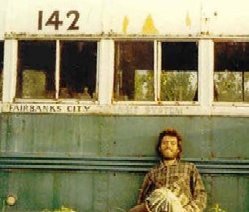
I thought this was kind of interesting (from the poetry foundation site).
Desire to Burn
by Tim Appelo
Kurt Cobain was a tenth-grade dropout who bitterly regretted his truncated education. Yet he was a scholar in his weird way, and not just of obscure B-sides. As he noted in his journals, “When I read, I read well.” Cobain’s poetic mentor was Courtney Love, the fitfully bookish granddaughter of novelist Paula Fox (ranked higher than Bellow, Roth, and Updike by Jonathan Franzen).
Love thrust improving books on him, and some he took to heart. He wrote out lines by the 1920s poet Elinor Wylie in his journals.
He was attracted by Wylie’s doomy voice, scandalous life, and young death by stroke the day after she finished her last book. He would have loved a Wylie line like “My flesh was but a fresh-embroidered shroud,” and these quatrains, about a hero who fled humanity to live in a cave:
If you would keep your soul
From spotted sight or sound,
Live like the velvet mole;
Go burrow underground.
And there hold intercourse
With roots of trees and stones,
With rivers at their source,
And disembodied bones.
But Cobain didn’t read with an open mind. He sought what resonated with his fiercely puritanical disenchantment, and with his plan to get rich and famous “and kill myself like Jimi Hendrix,” which he announced to at least seven friends in junior high school.
We can study his poetical imagination at work by reading the only poem in his published journals, “A Young Woman, a Tree,” by award-winning poet Alicia Ostriker. Cobain’s response to Ostriker’s poem demonstrates that he died by a willful act of misreading.
On page 204 of his journals, he incorporated “A Young Woman, a Tree” into a drawing. It was a page so painfully revealing that reviewers were forbidden to reprint it, presumably on Love’s orders. Cobain took a comic-book version of his life story, tore out the cartoon portrait of his head heroically shrieking his number-one lyric “Here we are now, entertain us,” and drew onto it a rather good expressionist sketch of his emaciated body. The drawing is meant to contrast the muscular comic-book superhero head—the public myth—with the shabby private reality of what he called his “Auschwitz” body, which shamed him.
Above the drawing, he clipped six lines from Ostriker. The girl in the poem envies a tree, whose explosion of fall color makes her own life feel pallid:
Passing that fiery tree—if only she could
Be making love,
Be making poetry,
Be exploding, be speeding through the universe
Like a photon, like a shower
Of yellow blazes—
Cobain places these lines above his self-portrait, which seems to represent a painful absence of creative energy. Ostriker tells me that this is her subject, too. “The poem is from the point of view of a girl who wants to live more intensely than she is doing.” But Cobain stops there, missing the ultimate point of the poem, which is one of endurance. The poem continues:
She believes if she could only overtake
The riding rhythm of things,
Of her own electrons,
Then she would be at rest
If she could forget school,
Climb the tree,
Be the tree,
Burn like that.
So far, Ostriker sounds the same yearning note that Cobain does elsewhere in the journals: “I used to have so much energy and the need to search for miles and weeks for anything new and different. Excitement. I was once a magnet for attracting new offbeat personalities who would introduce me to music and books of the obscure and I would soak it into my system like a rabid sex crazed junkie hyperactive mentally retarded toddler who’s just had her first taste of sugar.” If he didn’t get his idea fix, he got suicidal. When he sought refuge from despair in the creative process, it was a process very like suicidal sehnsucht.
But as the poem continues, the girl lives to learn the true lesson of creativity:
She doesn’t know yet, how could she
That this same need
Is going to erupt every September
And that in 40 years the idea will strike her
From no apparent source,
In a Laundromat
Between a washer and a dryer,
Like one of those electric light bulbs
Lighting up near a character’s head in a comic strip—
There in that naked and soiled place
With its detergent machines,
Its speckled fluorescent lights,
Its lint piles broomed into corners as she fumbles for quarters
And dimes, she will start to chuckle and double over
Into the plastic baskets’
Mountain of wet
Bedsheets and bulky overalls—
Old lady! She’ll grin,
beguiled at herself,
Old lady! The desire to burn is already a burning! How about that!
Maybe Cobain would never have been able to read the redemptive message of the poem. His imagination was all about the moment of explosiveness, not the wisdom of reflection. He felt he had exhausted all creative possibilities: if you think his posthumously released tune “You Know You’re Right” sounds like the same old formula, he felt the same way. In his journals, he sarcastically envisions Nirvana as a washed-up oldies act.
But his biochemistry made him believe from the start that all hope was exhausted before he was born. He writes in his early journals that it’s all been done, there’s no point in music, and yet “it’s still fun to pretend” that his generation could find a living music of its own. As the forbidden page shows, he no longer had the spirit to keep up the pretense. He could not see that his restless questing, his gnawing hunger to create, and his ability to pour that frustration into art was in itself potentially his deepest gift.
“What I wonder is where Cobain would have gotten to if he’d survived,” wrote Ostriker in a recent e-mail. “We are so drawn to the ones who burn out early—some sort of compelling romanticism about death fascinates us—the Cobain cult seems to me very much like the cult of Sylvia Plath as a poet. Passion and power as artists, tangled in poisonous self-contempt, contempt for the world, two sides of the same coin. Here are some lines of Plath’s, from the poem ‘Lady Lazarus’:
Dying
Is an art, like everything else.
I do it exceptionally well.
I do it so it feels like hell.
I do it so it feels real.
I guess you could say I’ve a call.
“If there’s an afterlife,” writes Ostriker, “I can picture Plath and Cobain prowling through it together.”
Monday, May 15, 2006
Kurt Cobain

Tuesday, May 09, 2006
Duino Elegies--Rainer Maria Rilke
The First Elegy
Who, if I cried out, would hear me among the angels'
hierarchies? and even if one of them pressed me
suddenly against his heart: I would be consumed
in that overwhelming existence. For beauty is nothing
but the beginning of terror, which we are still just able to endure,
and we are so awed because it serenely disdains
to annihilate us. Every angel is terrifying.
And so I hold myself back and swallow the call-note
of my dark sobbing. Ah, whom can we ever turn to
in our need? Not angels, not humans,
and already the knowing animals are aware
that we are not really at home in
our interpreted world. Perhaps there remains for us
some tree on a hillside, which every day we can take
into our vision; there remains for us yesterday's street
and the loyalty of a habit so much at ease
when it stayed with us that it moved in and never left.
Oh and night: there is night, when a wind full of infinite space
gnaws at our faces. Whom would it not remain for--that longed-after,
mildly disillusioning presence, which the solitary heart
so painfully meets. Is it any less difficult for lovers?
But they keep on using each other to hide their own fate.
Don't you know yet? Fling the emptiness out of your arms
into the spaces we breathe; perhaps the birds
will feel the expanded air with more passionate flying.
Yes--the springtimes needed you. Often a star
was waiting for you to notice it. A wave rolled toward you
out of the distant past, or as you walked
under an open window, a violin
yielded itself to your hearing. All this was mission.
But could you accomplish it? Weren't you always
distracted by expectation, as if every event
announced a beloved? (Where can you find a place
to keep her, with all the huge strange thoughts inside you
going and coming and often staying all night.)
But when you feel longing, sing of women in love;
for their famous passion is still not immortal. Sing
of women abandoned and desolate (you envy them, almost)
who could love so much more purely than those who were gratified.
Begin again and again the never-attainable praising;
remember: the hero lives on; even his downfall was
merely a pretext for achieving his final birth.
But Nature, spent and exhausted, takes lovers back
into herself, as if there were not enough strength
to create them a second time. Have you imagined
Gaspara Stampa intensely enough so that any girl
deserted by her beloved might be inspired
by that fierce example of soaring, objectless love
and might say to herself, "Perhaps I can be like her”?
Shouldn't this most ancient of sufferings finally grow
more fruitful for us? Isn't it time that we lovingly
freed ourselves from the beloved and, quivering, endured:
as the arrow endures the bowstring's tension, so that
gathered in the snap of release it can be more than
itself. For there is no place where we can remain.
Voices. Voices. Listen, my heart, as only
saints have listened: until the gigantic call lifted them
off the ground; yet they kept on, impossibly,
kneeling and didn't notice at all:
so complete was their listening. Not that you could endure
God's voice--far from it. But listen to the voice of the wind
and the ceaseless message that forms itself out of silence.
It is murmuring toward you now from those who died young.
Didn't their fate, whenever you stepped into a church in
Naples or Rome, quietly come to address you?
Or high up, some eulogy entrusted you with a mission,
as, last year, on the plaque in Santa Maria Formosa.
What they want of me is that I gently remove the appearance
of injustice about their death--which at times
slightly hinders their souls from proceeding onward.
Of course, it is strange to inhabit the earth no longer,
to give up customs one barely had time to learn,
not to see roses and other promising Things
in terms of a human future; no longer to be
what one was in infinitely anxious hands; to leave
even one's own first name behind, forgetting it
as easily as a child abandons a broken toy.
Strange to no longer desire one's desires. Strange
to see meanings that clung together once, floating away
in every direction. And being dead is hard work
and full of retrieval before one can gradually feel
a trace of eternity. Though the living are wrong to believe
in the too-sharp distinctions which they themselves have created.
Angels (they say) don't know whether it is the living
they are moving among, or the dead. The eternal torrent
whirls all ages along in it, through both realms
forever, and their voices are drowned out in its thunderous roar.
In the end, those who were carried off early no longer need us:
they are weaned from earth's sorrows and joys, as gently as children
outgrow the soft breasts of their mothers. But we, who do need
such great mysteries, we for whom grief is so often
the source of our spirit's growth--: could we exist without them?
Is the legend meaningless that tells how, in the lament for Linus,
the daring first notes of song pierced through the barren numbness;
and then in the startled space which a youth as lovely as a god
has suddenly left forever, the Void felt for the first time
that harmony which now enraptures and comforts and helps us.
Friday, May 05, 2006
Trickster Poetry
Coyotes in Greenwich!
Here hedges are upholstered, each cobblestone
has an appointment, greening boughs aspire
in vain to Tudor style while even ramblers
know their place. And yet, we saw hibiscus
in high alarm, cat-slunk shivering it.
Coyotes invade. They claim to be the truth.
Black bears nose the bougainvillea, moving
eastward, indiscriminate, original.
Our sinks back up, our toilets will not drain,
our nature disobediently tends toward nature.
But we will have no blame, for we attend
our garbage as we always have, bury
and send away what could not prosper here.
In children's books we keep foxes and mice;
where are the Apaches to back us up?
Logically we sleep, though not in comfort
these days. Our wives keep turning in our beds
like roasting meat, the stones call out to us,
campfires fringe the Merritt. In our kitchens
pasta forks bare fangs, pans hang like scalps.
-- Julie Sheehan
Dottie

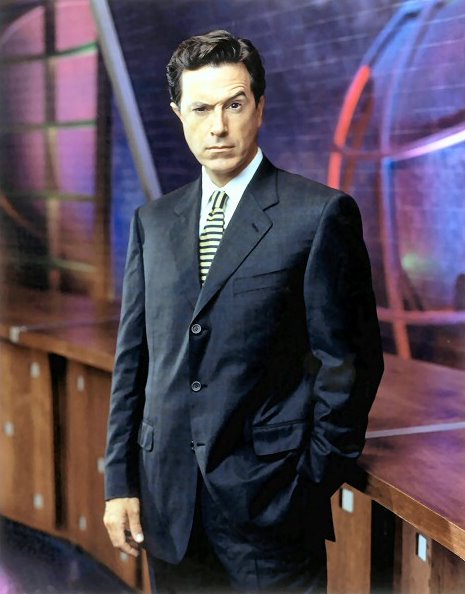
A couple weeks ago Dottie got a Urinary Tract Infection. After an emergency vet visit and a goodly amount of worry and money, things seem to be back to normal. After some research I am now a firm believer in giving her high-end canned food. This is a long ways from my childhood of throwing out the cheapest kibble possible to the barn cats. The main problem with kibble is that it has less than 10% moisture and the canned usually has around 75%. Cats evolved by getting almost all moisture from their food so it is almost impossible for a dry food fed cat to get the moisture it needs from a water bowl. This lack of water causes UTI's and a host of other problems. Additives and by-products are also a problem in dry and canned food so I've decided my precious kitty needs the most expensive food possible! We've been feeding her Wellness, but there are other good brands out there. Here are some links that go into the problem in more depth.
Cats live twenty years on dehydrated diseased cow parts all the time, but I feel like I should do the best I can since I have her locked up in this apartment.
Thursday, May 04, 2006
Evan S. Connell
I just started reading "Notes From A Bottle Found On The Beach At Carmel" by Evan S. Connell. Wow! is all I can say. I can't wait to try out his other books.
Wednesday, May 03, 2006
Tuesday, May 02, 2006
Poetry Today
Barbed Wire
One summer afternoon when nothing much
was happening, they were standing around
a tractor beside the barn while a horse
in the field poked his head between two strands
of the barbed-wire fence to get at the grass
along the lane, when it happened-something
they passed around the wood stove late at night
for years, but never could explain-someone
may have dropped a wrench into the toolbox
or made a sudden move, or merely thought
what might happen if the horse got scared, and
then he did get scared, jumped sideways and ran
down the fence line, leaving chunks of his throat
skin and hair on every barb for ten feet
before he pulled free and ran a short way
into the field, stopped and planted his hoofs
wide apart like a sawhorse, hung his head
down as if to watch his blood running out,
almost as if he were about to speak
to them, who almost thought he could regret
that he no longer had the strength to stand,
then shuddered to his knees, fell on his side,
and gave up breathing while the dripping wire
hummed like a bowstring in the splintered air.
--Henry Taylor
Monday, May 01, 2006
Walter Meayers Edwards

I've been trying to find out what is going on in this photo by Walter Meayers Edwards. No luck as of yet.
Does everyone think their "culture" is bland? I want to worship animals. Maybe I would start eating them then. As of now I feel fairly disconnected and wouldn't feel good about eating prepackaged meat stuff. What I wouldn't give for a garden!!
Thursday, April 27, 2006
Poetry Wednesday on Thursday
One Continuous Substance
A small boy and a slant of morning light
both exit the last dark trees of this forest, though
the boy is gone in an instant. Not
the light: it travels its famous 186,000 miles per second
to be this still gold bar
on the floor of the darkness. I suppose
that from the universe’s point of view
we do the same: a small boy and an old man
being one continuous substance.
We were making love when the phone rang
saying my father was dead, and the sun
kept touching you, there, and there, where I’d been.
by Albert Goldbarth
Wednesday, April 26, 2006
Poetry Wednesday
Check out the archives on the Poetry Foundation's website.
Sentimental
The light has traveled unthinkable thousands of miles to be
condensed, recharged, and poured off the white white pages
of an open Bible the country parson holds in front of this couple
in a field, in July, in the sap and the flyswirl of July
in upper Wisconsin, where their vows buzz in a ring in the air
like the flies, and are as sweet as the sap, in these rich and ritual minutes.
Is it sentimental? Oops. And out of that Bible the light continues
to rush as if from a faucet. There will be a piecrust cooling
out of its own few x’ed-out cuts. And will it make us run
for the picklier taste of irony rolled around protectively on our tongues
like a grab of Greek olives? My students and I discuss this
slippery phenomenon. Does “context” matter? Does
“earned” count? If a balled-up fidget of snakes
in the underbrush dies in a freeze is it sentimental? No,
yes, maybe. What if a litter of cocker spaniels? What
if we called them “puppydogs” in the same poem in that same hard,
hammering winter? When my father was buried,
the gray snow in the cemetery was sheet tin. If I said
that? Yes, no, what does “tone” or “history” do
to the Hollywood hack violinists who patiently wait to play
the taut nerves of the closest human body until from that
lush cue alone, the eyes swell moistly, and the griefs
we warehouse daily take advantage of this thinning
of our systems, then the first sloppy gushes begin . . .
Is that “wrong”? Did I tell you the breaths
of the gravediggers puffed out like factorysmoke
as they bent and straightened, bent and straightened,
mechanically? Are wise old (toothless) Black blues singers
sentimental?—“gran’ma”? “country cookin’”? But
they have their validity, don't they, yes? their
sweat-in-the-creases, picking up the lighting
in a fine-lined mesh of what it means to have gone through time
alive a little bit on this planet. Hands shoot up . . . opinions . . .
questions . . . What if the sun wept? the moon? Why, in the face
of those open faces, are we so squeamish? Call out
the crippled girl and her only friend the up-for-sale foal,
and let her tootle her woeful pennywhistle musics.
What if some chichi streetwise junkass from the demimonde
gave forth with the story of orphans forced through howling storm
to the workhouse, letting it swing between the icy-blue
quotation marks of cynicism—then? What if
I wept? What if I simply put the page down,
rocked my head in my own folded elbows, forgot
the rest of it all, and wept? What if I stepped into
the light of that page, a burnished and uncompromising
light, and walked back up to his stone a final time,
just that, no drama, and it was so cold,
and the air was so brittle, metal buckled
out song like a bandsaw, and there, from inside me,
where they’d been lost in shame and sophistry
all these years now, every last one of my childhood’s
heartwormed puppydogs found its natural voice.
by Albert Goldbarth
Monday, April 24, 2006
Point of Rocks, Morton Co. Kansas
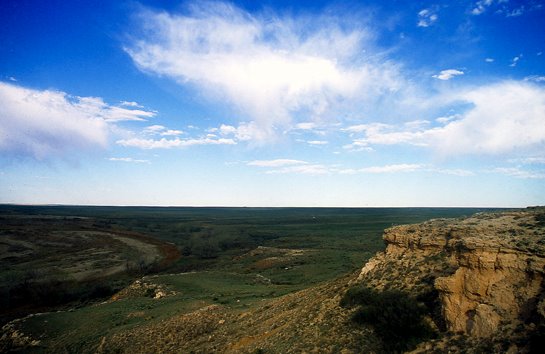
This is probably my favorite place on earth. Point of Rocks was a lookout for settlers on the Sante Fe Trail. You can still see the wagon ruts that follow the Cimarron River from the point. There were some poor farming practices in the 20's so when drought hit in the 30's the Dust Bowl also hit.
Morton County was one of the most devestated areas, but slowly the area recovered and was designated Cimarron National Grassland. Which is where yours truly has spent many a morning, day, and evening birding.

Saturday, April 22, 2006

Tuesday, April 18, 2006
Get Human!
Can't get a person on your credit card's customer service line? Try Get Human
"Our goal is to improve the quality of customer service and phone support in the US. This free website is run by volunteers and is powered by over one million consumers who demand high quality phone support from the companies that they use."
"The most popular part of the gethuman website is the gethuman database of secret phone numbers and codes to get to a human when calling a company for customer service. (See also our general tips.)"
Wednesday, April 12, 2006
Poem o' the Day
Where You Go When She Sleeps
by T R Hummer
What is it when a woman sleeps, her head bright
In your lap, in your hands, her breath easy now as though it had never been
Anything else, and you know she is dreaming, her eyelids
Jerk, but she is not troubled, it is a dream
That does not include you, but you are not troubled either,
It is too good to hold her while she sleeps, her hair falling
Richly on your hands, shining like metal, a color
That when you think of it you cannot name, as though it has just
Come into existence, dragging you into the world in the wake
Of its creation, out of whatever vacuum you were in before,
And you are like the boy you heard of once who fell
Into a silo full of oats, the silo emptying from below, oats
At the top swirling in a gold whirlpool, a bright eddy of grain, the boy
You imagine, leaning over the edge to see it, the noon sun breaking
Into the center of the circle he watches, hot on his back, burning
And he forgets his father's warning, stands on the edge, looks down,
The grain spinning, dizzy, and when he falls his arms go out, too thin
For wings, and he hears his father's cry somewhere, but is gone
Already, down in a gold sea, spun deep in the heart of the silo,
And when they find him, he lies still, not seeing the world
Through his body but through the deep rush of grain
Where he has gone and can never come back, though they drag him
Out, his father's tears bright on both their faces, the farmhands
Standing by blank and amazed - you touch that unnamable
Color in her hair and you are gone into what is not fear or joy
But a whirling of sunlight and water and air full of shining dust
That takes you, a dream that is not of you but will let you
Into itself if you love enough, and will not, will never let you go.
Tuesday, April 04, 2006
Hardy Bird
Hardy Bird
for Felix Stefanile
When I can hear my raucous sparrows sing,
I shed some gravity, then brace to fly
until their urgent chords start softening.
We echo notes like these to justify
dark hours with blank pages—time we spend
in ways no predator can comprehend.
Like sparrows pulling grubs from rotting oaks,
we peck obsessively; and if we pry
some morsels from the wood that satisfy
demands for sustenance, we try to coax
our throats to warble songs no soul has heard.
We are indebted to the steadfast man
who hears the sorrow of the striving bird
and spreads whatever crumbs of bread he can.
--A. M. Juster
Into The Wild
I'm using the book "Into The Wild" by Jon Krakauer in my Comp I class (like many others I'm coming to find). I read this book about Chris McCandless a.k.a Alexander Supertramp as I was nearing graduating from college. I think it was a big reason for me leaving grad school after one semester, along with other things. Many people believe he was stupid and died because of hubris. That is true, or at least partially so, but he also lived out his convinctions; how many of us can say that? This is the one picture of McCandless that is available to the public. He died in that bus.